
Last Updated on August 15, 2026 by Mat Diekhake
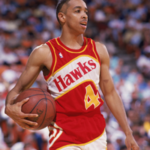 Spud Webb proved that determination and skill could outweigh size, building a successful NBA career despite standing well below the league average. Best known for his unforgettable Slam Dunk Contest victory, Webb also provided quickness, playmaking, and energy whenever he stepped onto the court.
Below is an overview of his personal background and professional career:
Player Profile
- Full Name: Anthony Jerome Webb
- Nationality: American
- Date of Birth: July 13, 1963
- Place of Birth: Dallas, Texas, USA
- Hometown: Dallas, Texas, USA
- Height: 5 feet 7 inches (170 cm)
- Weight: 133 pounds (60 kg)
- Wingspan: 5 feet 10 inches ((178cm)
- Shoe Size: Size 7 (US)
- Jersey Number: 4
- Position: Point Guard
- High School: Wilmer-Hutchins High School, Dallas, Texas
- College: Midland College; North Carolina State University
- NBA Draft: 1985, 4th round, 87th overall pick by the Detroit Pistons
- Teams Played For:
- Atlanta Hawks (1985–1991)
- Sacramento Kings (1991–1995)
- Atlanta Hawks (1995–1996)
- Minnesota Timberwolves (1996)
- Orlando Magic (1998)
- Championship Rings: None
- Children: Information not publicly available
- Siblings: Five siblings
Career Highlights:
- 1986 NBA Slam Dunk Contest Champion: Webb captivated audiences by winning the contest, showcasing his exceptional leaping ability.
- Professional Career: Played 12 seasons in the NBA, with notable tenures at the Atlanta Hawks and Sacramento Kings.
Personal Background:
- Born and raised in Dallas, Texas, Webb grew up in a modest household with his parents and five siblings.
- Despite being overlooked due to his height, he demonstrated exceptional talent and determination throughout his basketball career.
- Spud Webb’s legacy serves as an inspiration, proving that determination and skill can overcome physical limitations in professional sports.
Player Archetype / Play Style
Spud Webb was a jitterbug lead guard in the pure point-guard mold, a tiny but explosive playmaker whose game was built on speed, handle, balance, and nerve. Defensively, he worked mainly at the point of attack, using quick hands, pressure, and competitiveness to bother opposing ballhandlers even though his size naturally limited switching and contest range. Offensively, he operated as a pace-pushing table setter who could break down the first line, create for teammates, and chip in as a capable scorer, especially with pull-ups, floaters, and crafty finishes that played bigger than his frame. At roughly 5-foot-6 and 133 pounds, Webb’s unusual physical profile defined him, but so did his spring, body control, and burst, which made him far more dynamic than a standard small guard. The full package was that of a high-energy floor general: creative off the dribble, quick in transition, competitive on both ends, and skilled enough to turn elite agility into real offensive orchestration rather than novelty.
Scouting Report
Spud Webb’s height dominated the conversation, but it never really defined the player. What stood out on film was how quickly he turned tiny advantages into big ones. He changed speeds constantly, not just directions, and that made his first step far more dangerous than defenders expected because they were often reacting to hesitation rather than pure acceleration. In pick-and-rolls he had an excellent feel for splitting defenders who showed too high, and once he got into the paint he rarely stayed there long, using quick jump stops and wraparound passes to create passing windows before the weak-side help could close. He wasn’t simply probing for his own shot. He was forcing the defense to collapse, then delivering the ball from awkward angles that bigger guards often couldn’t see. Defensively, there were obvious physical limitations against taller guards, particularly when opponents tried to shoot over him or post him, but he compensated by crowding dribblers early, attacking loose handles and making entry passes far more difficult than they should have been. The trade-off was that teams with size could deliberately hunt those mismatches, making strong backline communication essential whenever he was switched onto wings. This is why his ideal fit is in an up-tempo offense with mobile bigs who sprint into ball screens and finish quickly, allowing his pace and creativity to dictate possessions before the defense is fully organized. Give him shooters who relocate after the initial action, and his vision becomes even more dangerous because he was always looking for the second read rather than settling for the first. To me, there are shades of T.J. McConnell in the relentless ball pressure and ability to create chaos without overwhelming athletic gifts, while his offensive rhythm occasionally resembled a smaller Tony Parker, using speed changes, angles and touch instead of trying to overpower defenders. Webb’s greatest skill wasn’t proving that a shorter player could survive in the league. It was making defenders forget about his size entirely until the possession was already over. — Mat Diekhake, HeatingUp
Sources: Spud Webb Stats, Height, Weight, Position, Draft — Basketball-Reference; Spud Webb | Guard — NBA.com; Spud Webb Career Stats — ESPN