
Last Updated on August 11, 2026 by Mat Diekhake
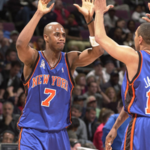 Lavor Postell was a versatile wing player whose athleticism and scoring ability helped him earn opportunities at both the college and professional levels. Although his NBA time was limited, he showed flashes of the all-around skill set that made him a respected player coming out of college basketball.
Player Profile
- Full Name: Andre Lavor Postell
- Nationality: American
- Date of Birth: February 26, 1978
- Hometown: Albany, Georgia
- Height: 6 feet 6 inches (198 cm)
- Weight: 215 pounds (98 kg)
- Wingspan: 6 feet 7 inches
- Shoe Size: Size 14 (US)
- Jersey Numbers: 7, 18
- Position: Shooting Guard / Small Forward
- High School: Westover High School, Albany, Georgia
- College: St. John’s University (1996–2000)
- NBA Draft: Selected by the New York Knicks in the 2nd round (39th overall) of the 2000 NBA Draft.
- Teams Played For:
- NBA:
- New York Knicks (2000–2003)
- International:
- Asheville Altitude (2003–2004)
- Olympiacos (2004–2005)
- Scavolini Pesaro (2005)
- Telindus Oostende (2005–2007)
- Geofin Nový Jičín (2008)
- Panteras de Miranda (2009)
- Búcaros de Bucaramanga (2009)
- NBA:
- Career Highlights:
- NBDL Champion with Asheville Altitude (2004)
- Family:
- Information about children and siblings is not publicly available.
Player Archetype / Play Style
Lavor Postell was a strong-framed swingman who fit the archetype of a complementary wing scorer, capable of sliding between shooting guard and small forward depending on lineup needs. Defensively, he projected as a physical perimeter option who could absorb contact, hold his ground on the wing, and check bigger guards or smaller forwards with toughness more than pure explosiveness. Offensively, his role centered on secondary scoring, spot-up shooting, and straight-line drives rather than high-level shot creation, making him more useful as a support piece than a primary initiator. At roughly 6-foot-5 and 215 pounds, Postell had the compact, sturdy build teams looked for in a two-position wing, and his overall style was direct and workmanlike—built on strength, floor spacing, and dependable complementary play rather than flair.
Scouting Report
The interesting thing about Lavor Postell was that he never looked interested in dominating the ball, yet he’d quietly become a problem if a defense forgot about him for two or three possessions. His offensive game was built around patience. He spaced the floor well, slid into open windows as the ball changed sides, and preferred attacking a defender who was already off balance instead of forcing difficult isolations. When he put the ball on the floor, it was usually with a purpose—one or two dribbles to reach the elbow, get all the way to the rim, or draw enough help to kick the ball back out. He wasn’t the kind of wing who consistently bent a defense with explosive first-step speed, and that’s where the limitations showed against longer, more physical defenders who could crowd his handle and make him settle for contested jumpers. Defensively, he understood positioning better than he gets credit for. He stayed connected to shooters, rotated on time from the weak side, and rarely abandoned the team structure chasing a risky steal. It’s easy to overlook those possessions because they don’t produce highlights, but they prevented breakdowns before they happened. To me, his value came from fitting cleanly into an offensive ecosystem rather than becoming its focal point. He could fill either wing spot, keep the floor balanced, and capitalize when primary creators forced defensive rotations without disrupting the rhythm of the offense by overdribbling. Put him alongside a ball-dominant guard or a playmaking forward and his feel for moving into passing lanes and taking efficient shots becomes much more noticeable. His game shared similarities with Shandon Anderson as a complementary perimeter option, while also carrying shades of Greg Buckner offensively when asked to embrace a low-usage role built on spacing, timely cuts, and dependable positional defense rather than individual shot creation. — Mat Diekhake, HeatingUp
Sources:
Player profile — Basketball-Reference
Official player page — NBA
College profile — Sports-Reference CBB
Draft profile — The Draft Review