
Last Updated on August 11, 2026 by Mat Diekhake
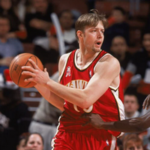 Hanno Möttölä became one of Finland’s most recognizable basketball players after building a strong reputation through both college and international competition. Known for his size and polished shooting touch as a forward, he helped open the door for more Finnish players to gain attention on the global basketball stage.
Player Profile
- Full Name: Hanno Aleksanteri Möttölä
- Nationality: Finnish
- Date of Birth: September 9, 1976
- Hometown: Helsinki, Finland
- Height: 6 feet 11 inches (211 cm)
- Weight: 247 pounds (112 kg)
- Wingspan: 7 feet 0 inches
- Shoe Size: Size 18 (US)
- Jersey Number: 13
- Position: Power Forward / Center
- High School: Mäkelänrinne Sports High School, Helsinki, Finland
- College: University of Utah (1996–2000)
- Played under coach Rick Majerus.
- Named to the 1999 and 2000 Mountain West First Team.
- NBA Draft: Selected by the Atlanta Hawks in the 2nd round (40th overall) of the 2000 NBA Draft.
- Teams Played For:
- NBA:
- Atlanta Hawks (2000–2002)
- International:
- Baskonia Vitoria-Gasteiz (Spain)
- Fortitudo Bologna (Italy)
- Scavolini Pesaro (Italy)
- Dynamo Moscow (Russia)
- Žalgiris Kaunas (Lithuania)
- Aris Thessaloniki (Greece)
- NMKY Helsinki (Finland)
- NBA:
- Career Highlights:
- First Finnish player to play in the NBA.
- Represented Finland in international competitions, including the 1995 European Championship.
- Championship Rings: None
- Family:
- Married to Ulla Leinikan.
- Information about children and siblings is not publicly available.
Player Archetype / Play Style
Hanno Möttölä was a skilled stretch big who fit the archetype of a finesse frontcourt scorer, blending traditional size with enough shooting touch to play as a modernized power forward-center rather than a bruising interior-only big. Defensively, he profiled more as a positional team defender than a rim-dominating anchor, using size and awareness to compete on the glass and hold his space inside. Offensively, his role centered on complementary scoring: finishing near the basket, stepping out to hit face-up jumpers, and giving lineups a bit of spacing and ball movement from the frontcourt. At 6-foot-11 and 247 pounds, Möttölä had legitimate NBA size, but his game leaned more toward skill, touch, and offensive versatility than sheer force. His overall style was composed and fundamentally sound, built on size, polish, and scoring adaptability across the high post and interior.
Scouting Report
Hanno Möttölä never struck me as the type of big who wanted every possession to begin with his back to the basket. The first thing you noticed was how comfortable he was playing within the flow of an offense, drifting into open space around the elbows, making himself available for a reversal, then attacking before the defense could fully reset. He had enough touch to punish defenders who gave him room, but he was just as willing to keep the ball moving instead of forcing a shot that wasn’t there. That’s where his offensive value lived. He wasn’t going to overpower centers on deep post seals or explode past quicker forwards, so he relied on timing, balance, and an understanding of angles to create workable looks inside the arc. Defensively, he was fundamentally sound more than disruptive. He usually arrived where the scheme expected him to be, showed enough discipline in drop coverage to discourage easy drives, and boxed out with good technique rather than chasing spectacular blocks. The trade-off was that quicker offensive players could pull him away from the paint and expose some limitations changing directions, while stronger interior scorers could move him deeper under the rim than he preferred. To me, he fit best next to an athletic interior defender who could handle the more demanding rim-protection responsibilities, allowing Möttölä to operate as the floor-spacing frontcourt partner who kept possessions connected at both ends. It’s easy to overlook how valuable his decision-making was because it rarely produced highlights; he understood when to swing the ball, when to take the open jumper, and when to cut after a teammate drew help instead of standing stationary. His game shared similarities with Matt Bonner’s measured offensive approach, though he worked more frequently from the mid-range, while also resembling Lee Nailon in the way he searched for efficient scoring opportunities without dominating possessions. — Mat Diekhake, HeatingUp
Sources:
Player profile — Basketball-Reference
Official NBA profile — NBA
International team stats overview — Basketball-Reference International