
Last Updated on August 12, 2026 by Mat Diekhake
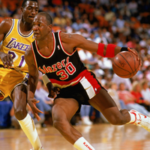 Terry Porter built a reputation as a dependable point guard who balanced scoring, playmaking, and leadership throughout a long NBA career. His steady presence helped anchor successful teams, and he later carried that experience into coaching roles after his playing days were over.
Player Profile
Personal Information:
- Full Name: Terry Porter
- Nationality: American
- Date of Birth: April 8, 1963
- Hometown: Milwaukee, Wisconsin, USA
- Height: 6 feet 3 inches (190 cm)
- Weight: 195 pounds (88 kg)
- Position: Point Guard
- Jersey Number: 30
Education:
- High School: South Division High School, Milwaukee, Wisconsin
- College: University of Wisconsin–Stevens Point
Professional Career:
- NBA Draft: Selected in the 1st round (24th overall) by the Portland Trail Blazers in the 1985 NBA Draft
- Teams Played For:
- Portland Trail Blazers (1985–1995)
- Minnesota Timberwolves (1995–1998)
- Miami Heat (1998–1999)
- San Antonio Spurs (1999–2002)
- NBA Championship Rings: None
Career Highlights:
- Two-time NBA All-Star (1991, 1993)
- Portland Trail Blazers all-time leader in assists
- Jersey number 30 retired by the Portland Trail Blazers
Post-Retirement:
- Served as head coach for the Milwaukee Bucks (2003–2005) and Phoenix Suns (2008–2009)
- Head coach of the University of Portland men’s basketball team (2016–2021)
Personal Life:
- Family: Married to Susie; they have three children: Brianna, Franklin, and Malcolm
- Siblings: Youngest of six children
Player Archetype / Play Style
Terry Porter fit the archetype of a steady floor-general point guard, the kind of lead ball-handler who could organize an offense, make sound reads, and still punish teams with timely scoring. Defensively, he handled regular backcourt assignments and brought value through positioning, toughness, and discipline more than flashy disruption. Offensively, he operated as a primary initiator who balanced playmaking with efficient perimeter scoring, especially as a shooter who could space the floor when defenses sagged. Physically, Porter was listed at 6’3″ and 205 pounds by NBA.com, giving him a sturdy guard frame that matched his controlled, durable style. His overall play style was calm and efficient: a smart, reliable point guard who kept offenses on schedule, made the extra pass, hit big outside shots, and blended leadership with low-drama production. (NBA)
Scouting Report
The interesting thing about Terry Porter is that he never seemed rushed, even when the possession demanded quick decisions. He controlled games by understanding where the next advantage was coming from rather than trying to force one himself. In pick-and-rolls, he patiently manipulated the screen, keeping his defender attached long enough to freeze the big before pulling up from mid-range, stepping into a three, or slipping a pass to a roller at exactly the moment the help rotated. He wasn’t the type to overdribble looking for a highlight; most of his offense came from reading the defense correctly on the first or second option, which made him an ideal lead guard for structured half-court offenses. What stands out is how balanced his scoring profile was. Defenders couldn’t simply duck under every screen because he punished that space with confident shooting, but pressing too high opened driving lanes where he used hesitation moves and strong footwork more than raw burst to get all the way to the rim. Defensively, he competed with discipline, navigating screens well enough to stay involved in the action and understanding when to stunt toward the ball before recovering to shooters, although bigger, more explosive guards could create separation by attacking him physically. The trade-off was that he rarely bent a defense through overwhelming athleticism or improvisation, so possessions depended more on collective execution than individual creation when late-clock situations became chaotic. That’s why Porter fit best alongside active screeners, intelligent cutters, and wings who recognized openings as quickly as he did, because he consistently rewarded movement without dominating the ball. To me, his game always resembled Mike Conley’s measured orchestration and Mark Price’s blend of perimeter shooting and pick-and-roll command, built on precision, timing, and an understanding that controlling tempo often creates cleaner offense than trying to outrun the defense. — Mat Diekhake, HeatingUp
Sources: Terry Porter player profile — NBA.com; Terry Porter stats, height, weight, position, draft status and more — Basketball-Reference; Blazers Top 100: The Guard Nobody Knew — Blazer’s Edge; Terry Porter (1963–) — The Oregon Encyclopedia