
Last Updated on August 12, 2026 by Mat Diekhake
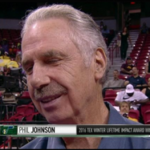 Phil Johnson carved out a respected place in basketball through decades of coaching, earning a reputation for his steady approach and attention to detail. While he never sought the spotlight, his influence could be seen in the development of players and teams across several eras of the game.
Player Profile
Personal Information:
- Full Name: Philip Donald Johnson
- Nationality: American
- Date of Birth: September 6, 1941
- Hometown: Grace, Idaho, USA
- Height: 6 feet 5 inches (1.96 meters)
- Weight: 190 pounds (86 kilograms)
- Wingspan: 6 feet 6 inches
- Position: Power Forward / Center
- Jersey Number: Not specified
Education:
- High School: Grace High School, Grace, Idaho
- College:
- Weber State University (1960–1961)
- Utah State University (1961–1963)
Playing Career:
- College Highlights:
- Averaged 12.3 points and 7.1 rebounds per game during his senior year at Utah State University.
- Helped lead the Aggies to consecutive NCAA Tournament appearances in 1962 and 1963.
Coaching Career:
- Weber State University:
- Assistant Coach (1964–1968)
- Head Coach (1968–1971)
- Led the team to three consecutive Big Sky Conference titles.
- Named Big Sky Coach of the Year three times.
- NBA Coaching Career:
- Assistant Coach for the Chicago Bulls (1971–1973)
- Head Coach for the Kansas City-Omaha/Kansas City Kings (1973–1978)
- Named NBA Coach of the Year in 1975.
- Assistant Coach for the Chicago Bulls (1979–1982)
- Assistant Coach for the Utah Jazz (1982–2011)
Achievements:
- NBA Coach of the Year (1975)
- Inducted into the Weber State University Sports Hall of Fame (1992)
- Inducted into the Utah Sports Hall of Fame (2011)
- Recipient of the inaugural Tex Winter Assistant Coach Lifetime Impact Award (2016)
- Inducted into the Utah State University Athletic Hall of Fame (2016)
Personal Life:
- Family: Married to Ann Johnson; they have two children, Mitchel and Nathan, and two grandchildren, McKenna and Alexander.
Player Archetype / Play Style
Phil Johnson projected as a sturdy backcourt connector rather than a high-volume star, fitting the archetype of a fundamentally sound guard who could score when needed while keeping the offense organized. Defensively, his role appears to have been more positional than disruptive, using effort and awareness to hold his ground on the perimeter instead of gambling for plays. Offensively, he functioned as a secondary scorer and steadying ball-handler, helping move possessions along rather than dominating them. Physically, Johnson was listed at 6’5″ and 180 pounds, which gave him good size for a guard in his era and enough length to play with balance on both ends. His overall style reads as practical and team-oriented: composed, disciplined, and built around clean execution, complementary scoring, and dependable all-around guard play. (Wikipedia)
Scouting Report
Phil Johnson wasn’t the type of guard who overwhelmed games with shot volume or flashy improvisation. To me, his value came from how calmly he connected possessions. He played with a measured pace, keeping his dribble alive until a passing lane opened, then delivering the ball on time rather than chasing the spectacular read. In pick-and-roll situations, he was comfortable drawing the first defender before feeding the screener in stride or reversing the ball quickly if the defense loaded up, and he rarely forced offense when the advantage wasn’t there. His scoring came more from balance than aggression—pull-up jumpers when defenders retreated, straight-line drives if the lane opened, and opportunistic finishes around the basket instead of difficult self-created attempts. That’s where his game separated itself. He understood that a simple play made early often produced a better shot than holding the ball for something complicated. Defensively, Johnson relied on positioning and anticipation, steering ball handlers toward help, staying attached through off-ball movement, and making clean rotations when the action shifted sides. Bigger, more physical guards could dislodge him near the paint, and he wasn’t the kind of explosive athlete who consistently recovered after being beaten off the dribble, so his effectiveness depended on staying one step ahead with angles rather than foot speed. I’ve always thought players like Johnson fit best beside dynamic scorers because they keep the offense organized without demanding constant touches, allowing the primary creators to attack while ensuring the ball continues to move once the first action breaks down. It’s easy to overlook how valuable that can be until an offense loses its rhythm. Stylistically, his game shared similarities with Steve Blake in the way he prioritized control over creativity, while parts of his steady decision-making and understated floor leadership also echoed Brian Shaw, guards who understood that creating a quality possession often starts with making the uncomplicated play before anyone notices it. — Mat Diekhake, HeatingUp
Sources: Phil Johnson player and coaching biography — Wikipedia; Phil Johnson Hall of Fame profile — Utah State Aggies; Phil Johnson college coaching and playing record — Sports Reference