
Last Updated on August 12, 2026 by Mat Diekhake
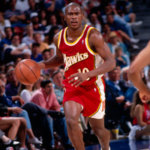 Mookie Blaylock made his mark as a relentless defender who seemed to be everywhere on the court, turning steals into one of the defining parts of his game. He paired that defensive intensity with reliable playmaking and outside shooting, helping anchor competitive teams throughout the 1990s.
Below is an overview of his personal background and professional career:
Player Profile
- Full Name: Daron Oshay Blaylock
- Nationality: American
- Date of Birth: March 20, 1967
- Place of Birth: Garland, Texas, USA
- Height: 6 feet 0 inches (183 cm)
- Weight: 180 pounds (81 kg)
- Wingspan: 6 feet 1 inch
- Shoe Size: Size 10 (US)
- Jersey Number: 10
- Position: Point Guard
- High School: Garland High School, Garland, Texas
- Colleges:
- Midland College
- University of Oklahoma
- NBA Draft: 1989, 1st round, 12th overall pick by the New Jersey Nets
- Teams Played For:
- New Jersey Nets (1989–1992)
- Atlanta Hawks (1992–1999)
- Golden State Warriors (1999–2002)
- Championship Rings: None
- Children: Information not publicly available
- Siblings: Information not publicly available
Player Archetype / Play Style
Mookie Blaylock was the archetype of a defense-first lead guard: a ball-hawking point guard who could run an offense, pressure the ball for full possessions, and still space the floor when needed. On defense, he was a disruptive perimeter stopper with quick hands, sharp anticipation, and constant activity in passing lanes, which is why he became a two-time steals leader and a multiple-time All-Defensive selection. Offensively, he worked as a table-setter first but also gave teams real value as a pull-up and spot-up perimeter shooter, capable of pushing tempo, creating for others, and punishing defenses that went under screens. Physically, Blaylock was not overwhelming in size for the position at roughly 6-foot and 180 pounds, but he was compact, fast, strong enough to absorb contact, and unusually aggressive for a guard on the glass. His overall style blended pest-like point-of-attack defense, steady playmaking, and timely outside shooting, making him one of the more complete two-way point guards of the 1990s. (NBA)
Scouting Report
Mookie Blaylock defended the game as if every dribble was an opportunity rather than a responsibility. The first thing you notice isn’t the steals themselves—it’s how he manufactured them. He’d shade a ball handler toward the sideline, disguise his reach until the dribble came slightly outside the frame, then explode through the passing lane before the offense realized the window had disappeared. Even when he wasn’t forcing turnovers, his pressure changed possessions because opposing guards started initiating offense a step farther from where they wanted. Offensively, he played with much more control than people sometimes remember. He could organize a pick-and-roll, reject a screen if the defender cheated over the top, and comfortably pull up behind it when defenders ducked under. His three-point shot stretched the floor enough that defenses couldn’t simply sag into the paint, while his handle was efficient rather than flashy, always geared toward creating a passing angle or getting into his jumper. It’s easy to overlook that he rarely overdribbled. The ball moved when it should move, and when help defenders collapsed he consistently found shooters without forcing ambitious cross-court passes. The trade-off came around the rim. Against bigger interior defenders, finishing through contact wasn’t always his strength, so possessions could stall if an offense depended on him to live in traffic. That’s why his ideal role is leading a team that plays with pace, active screening and multiple perimeter shooters, allowing his penetration to distort defensive shape instead of asking him to beat packed lanes on his own. Defensively, he fit almost any aggressive scheme—full-court pressure, ICE coverage on side pick-and-rolls or switching late in possessions—because he processed actions so quickly and recovered without giving away balance. To me, his game sits somewhere between Jrue Holiday and Mike Conley. Holiday brings the same physical disruption at the point of attack, Conley the measured offensive decision-making, but Blaylock leaned even harder into turning defense into instant offense, making every loose handle or lazy pass feel like an invitation rather than a chance encounter. — Mat Diekhake, HeatingUp
Sources: NBA.com — Atlanta Hawks single-season steals per game leaders; NBA.com — Year-by-year NBA All-Defensive Teams; NBA.com — Season Review: 1996-97; Basketball-Reference — Mookie Blaylock Stats, Height, Weight, Position, Draft Status and more