
Last Updated on September 17, 2026 by Mat Diekhake
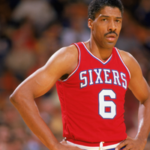
Julius Erving changed the way basketball looked, bringing soaring athleticism, effortless creativity, and spectacular above-the-rim finishes to a generation that had never seen anything quite like him. Revered as “Dr. J,” he became one of the sport’s most influential icons, inspiring countless future stars while building a championship legacy across both the ABA and NBA.
Here’s a detailed profile of basketballer Julius Erving:
- Full Name: Julius Winfield Erving II
- Nationality: American
- Date of Birth: February 22, 1950
- Birthplace: Roosevelt, New York, USA
- Hometown: Roosevelt, New York, USA
- Height: 6 feet 6 inches (1.98 meters)
- Weight: 210 pounds (95 kg)
- Wingspan: 7 ft 0 in (2.13 m)
- Shoe Size: Size 15 (US)
- Number: Wore #6 and #32 during his career
- Position: Small Forward
- High School: Roosevelt High School (Roosevelt, New York)
- College:
- University of Massachusetts Amherst
- Averaged 20.2 points and 20.2 rebounds per game during his college career.
- University of Massachusetts Amherst
- Draft: Drafted by the Milwaukee Bucks in the 1972 NBA Draft, selected in the first round as the 12th overall pick.
- ABA (American Basketball Association):
-
- Virginia Squires (1971–1973)
- New York Nets (1973–1976)
- He won two ABA championships with the Nets in 1974 and 1976.
- NBA (National Basketball Association):
-
- Philadelphia 76ers (1976–1987)
- He joined the NBA when the ABA and NBA merged in 1976.
- He won an NBA championship with the 76ers in 1983.
- Philadelphia 76ers (1976–1987)
- Career Highlights:
- NBA Champion (1983) with the Philadelphia 76ers
- 2× ABA Champion (1974, 1976)
- 4× NBA MVP (3× ABA, 1× NBA – 1981)
- 11× NBA All-Star (1977–1987)
- 5× ABA All-Star (1972–1976)
- NBA All-Star Game MVP (1977, 1983)
- 5× All-NBA First Team (1978, 1980–1983)
- ABA Scoring Champion (1973)
- Inducted into the Naismith Memorial Basketball Hall of Fame in 1993
- Named to the NBA’s 50th Anniversary Team and 75th Anniversary Team
- Famous for his high-flying dunks and incredible athleticism, revolutionizing the style of play.
- Career Statistics: Career averages of 24.2 points, 8.5 rebounds, and 4.2 assists per game across his ABA and NBA career.
- Championship Rings:
- 1 NBA Championship with the Philadelphia 76ers in 1983.
- 2 ABA Championships with the New York Nets (1974, 1976).
- Kids: Julius Erving has five children: Jules, Corey, Jazmin, Alexandra, and Cheo.
- Siblings: Information about his siblings is not widely documented.
The player archetype of Julius Erving was a high-flying scoring forward who blended graceful athleticism with relentless rim pressure. His extraordinary body control turned drives and fast breaks into spectacular finishes, yet he was equally effective creating offense from the mid-post and drawing defenders before finding teammates. Erving also contributed as a versatile defender and rebounder, using his length, timing, and quickness to disrupt plays while thriving in an up-tempo, attacking style that helped redefine wing play.
Scouting Report
Julius Erving had a way of making defenders feel as though they had forced him into a bad shot, only for him to reshape the entire play in midair. His body control was extraordinary, but what stands out even more is how he attacked space before it disappeared. He didn’t wait for driving lanes to open—he created them with long, gliding strides, subtle hesitations and an instinct for beating help defenders to the spot rather than through them. Once he reached the paint, he could extend around shot blockers, reverse the ball to the opposite side of the rim or hang just long enough for the contest to drift past, turning heavily defended possessions into efficient finishes. His passing often grew out of that same pressure. As weak-side defenders collapsed, he’d calmly drop the ball to a big or fire it to the perimeter without breaking stride, understanding that forcing rotations was often more valuable than forcing shots. Defensively, Erving covered ground with remarkable ease, jumping passing lanes without losing sight of his own assignment and using his length to challenge shots from unexpected angles. He wasn’t a bruising interior defender, and stronger forwards could create problems if they established deep post position, but his ability to recover from mistakes and generate transition opportunities after steals or rebounds changed the tempo of games. To me, he’d thrive in an offense that prioritizes pace, early attacks and open-floor decision-making because giving him room to gather momentum would stretch defensive coverages beyond their limits. It’s easy to overlook how effective he was in the half court simply because his transition highlights became so iconic. He understood spacing, cut with purpose and rarely overdribbled when a quick decision kept the defense on its heels. Stylistically, there are echoes of Giannis Antetokounmpo’s relentless rim pressure and Jayson Tatum’s ability to score from multiple areas of the floor, but Erving’s combination of fluidity, improvisation and aerial creativity gave his game a rhythm that remains almost impossible to replicate.
Fun Facts
- After retiring, Julius Erving worked in several business ventures and became involved in broadcasting and speaking engagements.
- He has also served as an executive with various professional sports teams and organizations.