
Last Updated on July 28, 2026 by Mat Diekhake
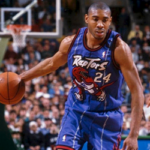
Jimmy King was an athletic NBA shooting guard whose slashing ability, perimeter defense, and transition play earned him opportunities with the Toronto Raptors and Denver Nuggets after starring as part of Michigan’s iconic Fab Five. His player profile highlights an explosive wing, strong finisher, and versatile backcourt contributor whose professional career was shorter than many expected.
Here is the detailed profile of Jimmy King:
Player Profile
- Full Name: James “Jimmy” Earl King
- Nationality: American
- Age: Born on August 9, 1973
- Hometown: South Bend, Indiana, USA
- Height: 6 feet 5 inches (1.96 meters)
- Weight: 210 pounds (95 kg) during his playing career
- Wingspan: 6 feet 6 inches
- Shoe Size: Size 14 (US)
- Number: 5, 21, 9 (depending on the team)
- Position: Shooting guard / Small forward
- High School: Plano East Senior High School (Plano, Texas)
- College: University of Michigan (1991–1995) – Member of the “Fab Five”
- NBA Draft: 1995, 2nd round, 35th overall pick by the Toronto Raptors
- Teams Played For:
- Toronto Raptors (1995–1996)
- Played in various international leagues and minor leagues post-NBA, including the Continental Basketball Association (CBA)
- Championship Rings: None
- Kids: Information about his children is not widely publicized
- Siblings: Information about his siblings is not widely available
Player Archetype / Play Style
Jimmy King’s player archetype was that of an athletic two-way wing, a strong-framed shooting guard who brought slashing offense, transition finishing, and sturdy perimeter defense more than pure shot-creation flair. At 6’5″ and 210 pounds, he had the size and strength to absorb contact, defend opposing guards and wings, and play a physical brand of basketball that fit his era. Defensively, his role was to pressure the ball, stay attached on the perimeter, and use his tools to contest across multiple matchups, while offensively he operated best as a straight-line driver, secondary scorer, and complementary playmaker who could fill lanes, attack closeouts, and keep the ball moving rather than dominate possessions. His overall play style was forceful, athletic, and team-oriented, making him the kind of guard who could help a lineup with toughness, defensive competitiveness, and efficient support scoring. (Basketball Reference)
Scouting Report
Jimmy King looked every bit the prototype wing until the ball was in his hands for too long. The physical tools naturally grabbed your attention, but what stood out to me was how much more effective he became when he embraced quick decisions instead of trying to create against a loaded defence. He ran the floor hard, filled the lanes in transition, attacked rotating defenders with long, direct drives and was at his best catching the ball on the move rather than sizing up his man from a standstill. In the half court he fit neatly into secondary actions, curling off pin-downs, cutting behind ball watchers and using one or two dribbles to get to the rim before the weak-side help could fully rotate. That’s where his offensive game had real value. He could make the simple read if a defender stepped over, but asking him to orchestrate pick-and-rolls possession after possession or break down compact defences generally played away from his strengths. Defensively, King had the length and lateral movement to bother opposing wings at the point of attack. He stayed attached through screens, contested jumpers without giving away easy driving angles and used his frame to absorb contact on straight-line attacks, although highly skilled ball handlers who changed pace repeatedly could force him into recoveries where his discipline occasionally slipped. The trade-off was that his offensive impact often depended on the quality of the creators around him. Put him next to a guard who consistently bent the defence and his cutting, transition finishing and spot-up shooting became much more influential because he didn’t need many touches to affect the game. To me, there were shades of Greg Minor in the way he filled a complementary wing role, while parts of his game also echoed Kendall Gill without Gill’s level of on-ball creation. It’s easy to focus on what King wasn’t as a scorer, but his best stretches came when he stopped chasing difficult offence and simply punished every defensive mistake with quick, decisive basketball.
Sources:
NBA.com — Jimmy King | Guard | Toronto Raptors
Basketball-Reference — Jimmy King Stats, Height, Weight, Position, Draft Status and more
RealGM — Jimmy King Player Profile, Indiana Pacers