
Last Updated on July 22, 2026 by Mat Diekhake
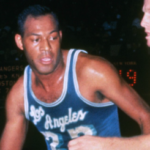
Elgin Baylor revolutionized the forward position with his acrobatic scoring, graceful athleticism, and ability to take over games long before above-the-rim play became commonplace. Despite never winning an NBA championship, his spectacular performances and lasting influence helped redefine what an elite offensive player could look like.
Here’s a full profile of Elgin Baylor, one of the most iconic players in NBA history:
- Full Name: Elgin Gay Baylor
- Nickname: Baylor, Mr. Inside, Rabbit
- Nationality: American
- DOB: Born on September 16, 1934; died: March 22, 2021 (aged 86)
- Hometown: Washington, D.C.
- Height: 6 ft 5 in (1.96 m)
- Weight: 225 lb (102 kg)
- Wingspan: 6 ft 11 in (2.11 m)
- Shoe Size: Size 14 (US)
- Jersey Number: #22 (retired by the Los Angeles Lakers)
- Position: Small Forward
- High School: Spingarn High School (Washington, D.C.)
- College:
- College of Idaho (1954–1955)
- Seattle University (1956–1958)
- NBA Draft: 1958 NBA Draft, round 1, 1st overall, selected by the Minneapolis Lakers
- Teams Played For: Minneapolis/Los Angeles Lakers (1958–1971)
- Accolades:
- NBA Career Achievements:
- 11× NBA All-Star (1959–1965, 1967–1970)
- 10× All-NBA Team:
- First Team: 1959–1965, 1967–1969
- Second Team: 1970
- NBA All-Star Game MVP (1959)
- NBA Rookie of the Year (1959)
- Other Career Highlights:
- NBA 75th Anniversary Team (2021)
- NBA 50th Anniversary Team (1996)
- Career Points Per Game Average: 27.4 PPG (Third all-time upon retirement)
- Career Rebounds Per Game Average: 13.5 RPG
- Scored 71 points in a game (1960) — one of the highest single-game scoring outputs in NBA history.
- Baylor holds the record for the most points scored in an NBA Finals game: 61 points in Game 5 of the 1962 Finals.
- NBA Career Achievements:
- Championship Rings: 0 NBA Championships (Baylor retired early in the 1971-1972 season, just before the Lakers won that year’s title)
- Kids: Elgin Baylor had three children:
- Alan Baylor
- Alison Baylor
- Krystal Baylor
- Siblings: Elgin Baylor had two brothers:
- Sal Baylor
- Kermit Baylor
The player archetype of Elgin Baylor was an explosive scoring forward whose creativity and athleticism transformed expectations for the position long before the modern era. He overwhelmed defenders with soaring finishes, twisting layups, and acrobatic body control that looked decades ahead of his time, while also carrying a massive offensive workload as the Lakers’ primary scorer. Baylor attacked the glass with authority despite giving up size to many frontcourt opponents, and his anticipation allowed him to contribute as a strong team defender and rebounder. Powerfully built yet remarkably agile, he thrived in transition, created difficult shots from awkward angles, and blended finesse with physicality in a style that influenced generations of high-scoring wings and forwards who followed.
Scouting Report
Elgin Baylor attacked defenders with a creativity that feels remarkably familiar even decades later. The first thing you notice is how often he changed direction in the air without losing balance, using hang time, body control and awkward release angles to finish around bigger defenders who thought they had forced him into difficult shots. He wasn’t simply an explosive leaper; he understood how to manipulate the final defender, delaying his finish until the contest had already passed. That same creativity carried into his half-court game, where he’d face up from the wing, attack either shoulder, or work from the post against smaller defenders without relying on repetitive moves. Once help collapsed, he was comfortable firing passes to cutters or kicking out to shooters, not because he was hunting assists but because defenses rarely had the luxury of staying home. Defensively, Baylor competed with physicality on the glass and had the quickness to stay connected against wings, while his anticipation allowed him to jump passing lanes without constantly gambling himself out of the play. The trade-off was that he wasn’t a dedicated rim protector or the type of defender you wanted orchestrating the back line, and his aggressive offensive style could occasionally lead him into heavily contested attempts when simpler options existed. Even so, that pressure on the paint was central to his value because it forced defenses into rotations they didn’t want to make. To me, he’d be devastating in an offense built around spread spacing, empty-side actions and quick decision-making, where driving lanes remained open and help defenders had farther to travel. His ability to attack from the wing, rebound in traffic and create offense without needing a ball screen would translate almost effortlessly. Stylistically, there are echoes of Jayson Tatum’s three-level scoring versatility and Julius Erving’s aerial creativity around the basket, but Baylor blended power, improvisation and touch in a way that gave his game a rhythm entirely his own, constantly forcing defenders to react instead of allowing them to dictate the possession.