
Last Updated on August 12, 2026 by Mat Diekhake
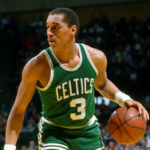 Dennis Johnson earned a reputation as one of the most complete guards of his generation, blending elite defense with timely scoring and strong leadership. He had a knack for delivering in important moments, which helped make him a vital part of multiple championship teams. Here’s an overview of his background and career:
Player Profile
- Full Name: Dennis Wayne Johnson
- Nationality: American
- Date of Birth: September 18, 1954
- Place of Birth: San Pedro, California, USA
- Date of Death: February 22, 2007
- Hometown: Compton, California, USA
- Height: 6 feet 4 inches (193 cm)
- Weight: 185 pounds (84 kg)
- Wingspan: 6 feet 5 inches
- Shoe Size: Size 13 (US)
- Jersey Numbers: 24 (Seattle SuperSonics), 3 (Boston Celtics)
- Position: Point Guard / Shooting Guard
- High School: Dominguez High School, Compton, California
- Colleges:
- Los Angeles Harbor College
- Pepperdine University
- NBA Draft: 1976, Round 2, 29th overall pick by the Seattle SuperSonics
- Teams Played For:
- Seattle SuperSonics (1976–1980)
- Phoenix Suns (1980–1983)
- Boston Celtics (1983–1990)
- Championship Rings: 3× NBA Champion
- 1979 with the Seattle SuperSonics
- 1984 and 1986 with the Boston Celtics
- Children: Three children with wife Donna Davis
- Siblings: Dennis was the eighth of sixteen children
- Career Highlights:
- Named NBA Finals Most Valuable Player (MVP) in 1979 with the Seattle SuperSonics.
- Selected to five NBA All-Star teams.
- Earned six All-NBA Defensive First Team honors.
- Inducted posthumously into the Naismith Memorial Basketball Hall of Fame in 2010.
Player Archetype / Play Style
Dennis Johnson was the archetype of a winning two-way guard: a tough, physical backcourt leader whose game was built first on defense, then on control, poise, and timely scoring. Defensively, he was an elite point-of-attack stopper and matchup guard, widely recognized for hounding star scorers, pressuring ballhandlers, and making life difficult across either guard spot, which is why his reputation has held up as the defining piece of his career. Offensively, he evolved from an athletic scoring guard into a steadier playmaker who could initiate sets, post smaller guards, hit mid-range pull-ups, and deliver in big moments without needing high volume. Physically, Johnson brought strong size for the backcourt at 6-foot-4 and 185 pounds, plus the ruggedness and balance to play through contact on both ends. His overall style was competitive, unglamorous, and deeply effective: a championship guard who imposed himself with defense, composure, and clutch all-around play rather than flashy numbers. (NBA)
Scouting Report
Dennis Johnson always seemed more interested in controlling the game than decorating it. What stands out is how adaptable he was from possession to possession. He could initiate offense through a high pick-and-roll, move off the ball into post-ups against smaller guards, or simply drift into the mid-range and wait for the defense to make a mistake. His scoring wasn’t built on dazzling separation. Instead, he relied on strength, balance and immaculate footwork to create just enough space for a reliable pull-up or turnaround. The interesting thing is that his passing often came after he had already forced the defense into rotation. He understood how to keep his dribble alive around the foul line, drawing help one extra step before slipping bounce passes to rolling bigs or kicking out to shooters relocating along the arc. Defensively, he was exceptional because he never defended only the man in front of him. He anticipated the next action, fought over screens without losing contact, timed digs at the nail to disrupt drives, and recovered with remarkable discipline instead of gambling himself out of position. Bigger wings couldn’t easily dislodge him, while smaller guards rarely found clean driving lanes. The trade-off was that he wasn’t a high-volume perimeter shooter, so there were stretches where defenders could go under ball screens or sag off him until he reached his preferred mid-range areas. That limitation mattered far less because he consistently punished defensive mistakes in other ways. This is why his ideal role is as the connective piece on a team with multiple scorers, where he can organize possessions when necessary, defend the opponent’s toughest perimeter assignment and quietly stabilize both ends of the floor without dominating the ball. Place him in a motion offense with intelligent cutters and screeners, and his decision-making becomes even more valuable because he rarely misses the extra pass once the defense begins to tilt. To me, his game shares elements of Jrue Holiday’s physical perimeter defense and Shaun Livingston’s composed offensive tempo, blending toughness, patience and basketball intelligence into a style that often looked understated until you realized he had influenced nearly every important possession. — Mat Diekhake, HeatingUp
Sources: NBA.com — Legends profile: Dennis Johnson; Basketball-Reference — Dennis Johnson Stats, Height, Weight, Position, Draft Status and More; CelticsBlog — History of Celtics retired numbers; NBA.com — NBA Birthdays: Players born on Sept. 18