
Last Updated on August 12, 2026 by Mat Diekhake
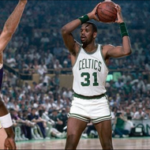 Cedric Maxwell was a smart and efficient scorer who excelled at finding ways to contribute without needing the spotlight. His steady play and ability to rise to the occasion in big games helped make him an important part of Boston’s championship success in the 1980s. Here’s an overview of his background and career:
Player Profile
- Full Name: Cedric Bryan Maxwell
- Nationality: American
- Date of Birth: November 21, 1955
- Hometown: Kinston, North Carolina, USA
- Height: 6 feet 8 inches (203 cm)
- Weight: 205 pounds (93 kg)
- Wingspan: 6 feet 9 inches
- Shoe Size: Size 16 (US)
- Jersey Numbers: 30, 31, 19, 18
- Position: Small Forward
- High School: Kinston High School, Kinston, North Carolina
- College: University of North Carolina at Charlotte (UNC Charlotte)
- NBA Draft: 1977, Round 1, 12th overall pick by the Boston Celtics
- Teams Played For:
- Boston Celtics (1977–1985)
- Los Angeles Clippers (1985–1987)
- Houston Rockets (1987–1988)
- Championship Rings: 2× NBA Champion with the Boston Celtics (1981, 1984)
- Children: Information not publicly available
- Siblings: Information not publicly available
- Career Highlights:
- Maxwell played a pivotal role in leading the UNC Charlotte 49ers to the NCAA Final Four in 1977.
- He was named the NBA Finals Most Valuable Player (MVP) in 1981.
- The Boston Celtics retired his jersey number 31 in honor of his contributions to the team.
- Post-retirement, Maxwell transitioned into radio broadcasting and has been serving as a color commentator for Celtics radio broadcasts since 2001.
Player Archetype / Play Style
Cedric Maxwell was an efficient interior forward archetype, the kind of smart, physical frontcourt scorer who thrived without needing star-level volume or flashy isolation play. Defensively, he handled rugged forward assignments, used positioning well, and competed with enough toughness to fit winning front lines even if his reputation leaned more toward reliability than shutdown defense. Offensively, he did his best work close to the basket, scoring through crafty low-post moves, fakes, offensive rebounding, and high-percentage finishes rather than perimeter shot-making, while also moving the ball well for his position. Physically, Maxwell brought a lean but rangy 6-foot-8 frame at about 205 pounds, and his overall style was heady, efficient, and competitive—an unorthodox but highly effective inside scorer whose feel, toughness, and timely play made him more valuable than his raw profile first suggested. (Basketball Reference)
Scouting Report
Cedric Maxwell understood something a lot of higher-volume scorers never quite do: efficiency often begins before the ball reaches your hands. What stands out is how patiently he worked for deep catches, using subtle changes of pace and clever footwork to seal defenders instead of wrestling for position. Once he established that angle, he was an excellent finisher with either hand, and he had a knack for waiting out shot blockers rather than challenging them head-on. The interesting thing is that he rarely looked like he was forcing offense. He picked his moments, slipped behind defenders when they lost vision of him, and thrived attacking gaps created by teammates instead of stopping the flow to manufacture difficult shots. When double teams arrived, he wasn’t trying to thread impossible passes, but he consistently found cutters or reversed the ball quickly enough to keep the defense rotating. Defensively, Maxwell relied on anticipation and body positioning more than raw explosiveness. He defended post players by beating them to spots, showed enough mobility to switch onto wings for stretches, and was particularly good at sliding over from the weak side to discourage drives before recovering under control. The trade-off was that he wasn’t the type of forward who stretched defenses from long range or created offense against loaded half-court defenses possession after possession, so asking him to function as a primary shot creator took him away from the instincts that made him so productive. This is why his ideal role is alongside a ball-dominant creator who attracts extra attention, allowing Maxwell to feast on post seals, baseline cuts, transition opportunities and quick actions flowing out of ball movement. Put him in a motion offense with smart passers and willing screeners, and his feel for finding open space becomes one of the offense’s quiet strengths. To me, there are shades of Paul Millsap in the understated efficiency and interior craft, while his ability to score without monopolizing possessions also brings to mind Tobias Harris at his best. Maxwell’s game wasn’t built around spectacular moments. It was built around consistently making the next possession a little easier for his team, and over the course of a game that added up to far more than the box score usually suggested. — Mat Diekhake, HeatingUp
Sources: NBA.com — Cedric Maxwell | Forward | Boston Celtics; Basketball-Reference — Cedric Maxwell Stats, Height, Weight, Position, Draft Status and More; CelticsBlog — Cedric Maxwell and all-time underrated Boston Celtics; NESN — Cedric Maxwell’s Celtics Legacy: 1981 Finals MVP, “Cornbread” Moments and Boston Titles