
Last Updated on July 28, 2026 by Mat Diekhake
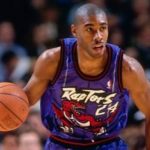
Acie Earl was a traditional NBA center whose size, shot-blocking, and low-post scoring provided interior depth for the Boston Celtics, Toronto Raptors, and Milwaukee Bucks during the 1990s. His player profile highlights a paint-oriented big man known for rim protection, rebounding, physical interior play, and a complementary frontcourt role.
Here is the detailed profile of Acie Earl:
Player Profile
- Full Name: Acie Boyd Earl
- Nationality: American
- Age: Born on June 23, 1970
- Hometown: Peoria, Illinois, USA
- Height: 6 feet 10 inches (2.08 meters)
- Weight: 240 pounds (109 kg) during his playing career
- Wingspan: 7 feet (2.13 meters)
- Shoe Size: Men’s US size 16
- Number: 55, 41, 33 (depending on the team)
- Position: Center / Power forward
- High School: Moline High School (Moline, Illinois)
- College: University of Iowa (1989–1993)
- NBA Draft: 1993, 1st round, 19th overall pick by the Boston Celtics
- Teams Played For:
- Boston Celtics (1993–1995)
- Toronto Raptors (1995–1996)
- Milwaukee Bucks (1996)
- Played overseas and in minor leagues post-NBA
- Championship Rings: None
- Kids: Information about his children is not widely publicized
- Siblings: Information about his siblings is not widely available
Player Archetype / Play Style
Acie Earl’s player archetype was that of a traditional rim-protecting center, a big-bodied interior presence whose value came from shot blocking, paint defense, rebounding, and functional low-post scoring rather than perimeter skill or offensive creativity. At 6’10” and 240 pounds, he had the size, length, and physical style to anchor the lane, challenge drivers, and play through contact, though his game was more rugged than fluid. Defensively, Earl’s best role was as a back-line deterrent who used timing and reach to erase shots around the basket, which lined up with the block production that defined his college résumé at Iowa. Offensively, he operated mostly as a close-range scorer and interior finisher, with some touch out to the mid-range, but his overall play style was built more on effort, size, and interior utility than polish, making him the kind of center who could help with toughness, protection at the rim, and straightforward frontcourt minutes. (Basketball Reference)
Scouting Report
Acie Earl always looked most comfortable when he could play with his back to the basket and let the game come to him instead of chasing it. He wasn’t trying to overwhelm defenders with brute force. Instead, he relied on length, soft hands and a patient sequence of pivots, up-and-unders and jump hooks, often using one move to set up the next rather than rushing the first shot available. What stands out is how naturally he presented himself as a target out of pick-and-rolls or high-low actions. Guards didn’t have to throw perfect passes because his reach expanded the passing window, and once he caught the ball around the lane he generally finished without bringing it down into traffic. Defensively, Earl was at his best stationed around the paint, where his timing as a shot blocker came from waiting for offensive players to commit before extending rather than constantly hunting blocks. He could alter plenty of attempts simply by staying vertical. The trade-off was that offences capable of dragging him into repeated pick-and-roll coverage or forcing him to defend away from the basket exposed some stiffness in his footwork. Quicker bigs could beat him to spots, and guards turning the corner with pace made his recoveries difficult. That’s why his ideal fit was in a structured defensive system that allowed him to anchor the lane while physical forwards handled more of the switching and perimeter mobility. Offensively, he complemented creators who consistently collapsed the defence because he understood how to seal late, occupy weak-side help and turn broken possessions into simple finishes instead of demanding touches. To me, there were elements of Luc Longley in the measured offensive approach and willingness to play within structure, while parts of his interior scoring package recalled Joe Kleine when given time to establish position. Earl’s game wasn’t built around speed or volume. It was built around making the paint feel crowded at one end and dependable at the other, and when the game stayed in that environment, he became a far more effective player than people often remember.
Fun Facts
- He was a member of the Toronto Raptors during their first year in the NBA as an expansion team.
- He struggled with the Celtics but was a very good player for the Toronto Raptors.
Sources:
Basketball-Reference — Acie Earl Stats, Height, Weight, Position, Draft Status and more
Hawkeye Sports — Iowa-Villanova to meet Sunday in Brooklyn
Los Angeles Times — Potential NBA First-Round Draft Picks