
Last Updated on August 11, 2026 by Mat Diekhake
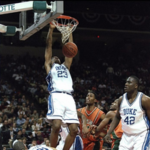 Chris Carrawell was known for his toughness, defensive effort, and ability to come through in important moments during his college basketball career. While his NBA run was brief, his leadership qualities and understanding of the game later helped him transition successfully into coaching.
Player Profile
- Full Name: Chris Carrawell
- Nationality: American
- Date of Birth: November 25, 1977
- Hometown: St. Louis, Missouri
- Height: 6 feet 6 inches (198 cm)
- Weight: 220 pounds (100 kg)
- Wingspan: 6 feet 7 inches
- Shoe Size: Size 14 (US)
- Jersey Number: 23
- Position: Shooting Guard / Small Forward
- High School: Cardinal Ritter College Prep, St. Louis, Missouri
- College: Duke University (1996–2000)
- As a senior, named ACC Player of the Year and a consensus first-team All-American.
- NBA Draft: Selected by the San Antonio Spurs in the 2nd round (41st overall) of the 2000 NBA Draft.
- Teams Played For:
- International:
- Played professionally in leagues across Europe, including in Italy, Poland, Germany, and the Netherlands.
- International:
- Coaching Career:
- Duke University:
- Joined the coaching staff in March 2018 as an assistant coach.
- Promoted to associate head coach in June 2021.
- Duke University:
- Parents: Raised by his mother, Joanne Hayes, in St. Louis.
- Siblings: Has siblings, though their names are not publicly disclosed.
Player Archetype / Play Style
Chris Carrawell was a rugged swingman who fit the archetype of a two-way complementary wing, able to slide between shooting guard and small forward because of his size, versatility, and all-around game. At 6-foot-6 and roughly 215 pounds, he had a strong, compact frame for a perimeter player, which helped him absorb contact and play with a physical edge. Defensively, he projected as a matchup wing who could guard across positions, using strength, discipline, and competitiveness more than elite burst. Offensively, his role leaned toward secondary creation and connective play: he could handle the ball, make the extra pass, attack in straight lines, and score without needing an offense built around him. His overall style was tough, flexible, and team-oriented, built on doing a bit of everything well and giving lineups a dependable two-way presence.
Scouting Report
Chris Carrawell always looked more comfortable creating problems for the player across from him than chasing numbers for himself. His offensive game was uncomplicated but effective because he understood where the advantage was coming from before he caught the ball. He’d cut behind an overplayed defender, duck into the lane when help shifted toward a star teammate, or attack a closeout with long, controlled strides instead of dancing with the dribble. There wasn’t much wasted movement. The trade-off was that he wasn’t the kind of perimeter scorer who could repeatedly manufacture offense late in the clock, and defenders who stayed balanced could coax him into contested pull-ups that weren’t really his game. Where I thought he separated himself was on the defensive end. He played with strong anticipation navigating off-ball screens, stayed attached through multiple actions without reaching, and had a knack for forcing ball handlers toward help rather than gambling for steals. Those possessions rarely ended with a highlight, but they often disrupted the first option of the offense and pushed teams deeper into the shot clock. It’s easy to overlook how physical he was before the catch, using his frame to make wings work for every touch instead of waiting until they already had an advantage. That’s the kind of defense coaches trust. His ideal role is alongside primary scorers who need a dependable perimeter partner willing to guard the tougher assignment, keep the ball moving, and capitalize on openings created by defensive rotations without demanding extra possessions. Put him in an offense built on drive-and-kick action and quick ball reversals, and his timing as a cutter and secondary attacker becomes much more valuable than a basic box score suggests. To me, his style falls somewhere between Mario Elie and Raja Bell—not because he mirrored either player exactly, but because all three understood that controlling a game from the wing often comes from winning dozens of small battles that barely register until you watch the film a second time. — Mat Diekhake, HeatingUp
Sources:
Player profile — Basketball-Reference
Draft coverage — GoDuke
Draft scouting report — ibiblio Draft Archive
College statistics — Sports-Reference CBB