
Last Updated on August 12, 2026 by Mat Diekhake
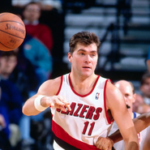 Arvydas Sabonis was a rare talent whose combination of size, vision, and skill made him one of the most respected big men the game has seen. Even after arriving in the NBA later in his career, he showed flashes of the all-around brilliance that had already made him a legend internationally.
Player Profile
Personal Information:
- Full Name: Arvydas Romas Sabonis
- Nationality: Lithuanian
- Date of Birth: December 19, 1964
- Hometown: Kaunas, Lithuania
- Height: 7 feet 3 inches (221 cm)
- Weight: 279 pounds (127 kg)
- Position: Center
- Jersey Number: 11
Career Highlights:
- International Achievements:
- Gold Medal with the Soviet Union at the 1988 Seoul Olympics.
- Bronze Medals with Lithuania at the 1992 Barcelona and 1996 Atlanta Olympics.
- Gold Medal at the 1982 FIBA World Championship.
- Club Career:
- Played for Žalgiris Kaunas (1981–1989), CB Valladolid (1989–1992), Real Madrid (1992–1995), and the Portland Trail Blazers (1995–2001, 2002–2003).
- Won the EuroLeague with Real Madrid in 1995.
- NBA Career:
- Drafted by the Portland Trail Blazers in the first round of the 1986 NBA Draft.
- Joined the NBA in 1995, playing seven seasons with the Trail Blazers.
- Named to the NBA All-Rookie First Team in 1996.
Honors:
- Inducted into the FIBA Hall of Fame in 2010.
- Inducted into the Naismith Memorial Basketball Hall of Fame in 2011.
Personal Life:
- Family:
- Married to Ingrida Mikelionytė, with whom he has four children.
- His son, Domantas Sabonis, is a professional basketball player in the NBA.
Player Archetype / Play Style
Arvydas Sabonis fit the archetype of a playmaking center, a rare offensive hub big who combined true interior size with passing vision more commonly associated with guards. Offensively, he could score on the block, hit from range, and pick apart defenses as a facilitator, which made him a highly unusual frontcourt creator for his era. Defensively, he filled a traditional center role around the paint, using his size and positioning to protect the interior and control the glass more than chase on the perimeter. Physically, Sabonis was listed by NBA.com at 7’3″ and 292 pounds, giving him massive frame, reach, and natural strength even after the injuries that shaped his later career. His overall play style was cerebral and versatile: a towering big man with soft hands, high-level touch, and a feel for the game that let him function as both a back-to-the-basket presence and a passing fulcrum. (NBA)
Scouting Report
The first thing you notice with Arvydas Sabonis isn’t the passing itself—it’s how early he sees the floor. Defenders are reacting to the ball while he’s already reading the second rotation, which is why so many of his best passes arrive before the opening is obvious. Operating from the elbows, the high post, or after drawing attention on the block, he constantly manipulated help defenders with subtle shoulder turns and patient pivots, creating backdoor cuts, weak-side kickouts, and high-low feeds without ever appearing rushed. He could punish single coverage with power and soft touch around the rim, yet he rarely hunted shots when a teammate had a cleaner look. That’s what made him so difficult to scheme against. Double him and the ball was gone before the trap arrived; stay home and he had the footwork and strength to carve out deep seals. The trade-off was that defending in space wasn’t his game. He was far more comfortable anchoring drop coverage, using his size and positioning to discourage drives than chasing guards around the perimeter, and offenses capable of forcing repeated switches or stretching him well beyond the paint could expose his lateral limitations. Even so, his defensive value came from understanding angles, absorbing contact, and making finishes uncomfortable rather than trying to erase everything above the rim. To me, Sabonis was the kind of offensive hub every coach wants because the ball never stuck. Put shooters around him, give him cutters willing to relocate without the ball, and every possession became a series of connected reads instead of isolated actions. It’s easy to overlook how much of his offense came from patience rather than flair. He wasn’t throwing difficult passes to impress anyone; he was waiting for defenders to make one small mistake. Stylistically, his game anticipated much of what Nikola Jokić later popularized from the center position, while sharing elements of Vlade Divac’s connective passing, though Sabonis brought a heavier interior scoring presence that forced defenses into far tougher choices. — Mat Diekhake, HeatingUp
Sources: Arvydas Sabonis player profile — NBA.com; Arvydas Sabonis stats, height, weight, position, draft status and more — Basketball-Reference; Arvydas Sabonis Hall of Fame profile — Naismith Basketball Hall of Fame; Trail Blazers Top 100: The Mountain Moves — Blazer’s Edge