
Last Updated on August 12, 2026 by Mat Diekhake
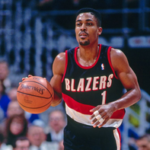 Rod Strickland was a gifted floor general whose creativity with the ball made him one of the most entertaining point guards of the 1990s. Known for threading impossible passes and controlling the pace of a game, he left a lasting impression on teammates, opponents, and fans alike.
Player Profile
Personal Information:
- Full Name: Rodney Strickland
- Nationality: American
- Date of Birth: July 11, 1966
- Hometown: Bronx, New York City, New York, USA
- Height: 6 feet 3 inches (190 cm)
- Weight: 175 pounds (79 kg)
- Wingspan: 6 feet 4 inches
- Position: Point Guard
- Jersey Number: 1
Education:
- High School: Harry S. Truman High School, Bronx, New York; Oak Hill Academy, Mouth of Wilson, Virginia
- College: DePaul University
Professional Career:
- NBA Draft: Selected in the 1st round (19th overall) by the New York Knicks in the 1988 NBA Draft
- Teams Played For:
- New York Knicks (1988–1990)
- San Antonio Spurs (1990–1992)
- Portland Trail Blazers (1992–1996)
- Washington Bullets/Wizards (1996–2001)
- Miami Heat (2001)
- Minnesota Timberwolves (2001–2002)
- Orlando Magic (2002–2003)
- Toronto Raptors (2003–2004)
- Houston Rockets (2004)
- NBA Championship Rings: None
Career Highlights:
- Led the NBA in assists per game during the 1997–98 season
- Named to the All-NBA Second Team in 1998
- Scored over 14,000 points and recorded nearly 8,000 assists during his NBA career
Post-Retirement:
- Served in various coaching and administrative roles, including positions at the University of Memphis and the University of Kentucky
- Assistant coach for the South Florida Bulls from 2014 to 2017
- Appointed head coach at Long Island University in 2022
Personal Life:
- Family: Rod Strickland is the godfather of NBA player Kyrie Irving.
- Siblings: Information about his siblings is not publicly available.
Player Archetype / Play Style
Rod Strickland fit the archetype of a crafty lead guard, a slashing playmaker whose game was built more on handle, touch, and improvisation than on pull-up volume or overpowering size. Defensively, he was typically a point-of-attack guard assignment, relying more on instincts and quick hands than on physical force or shutdown length. Offensively, he ran the show as a primary creator, collapsing defenses off the dribble, threading passes in tight spaces, and finishing at the rim with unusual creativity for a guard. Physically, Strickland was listed at 6’3″ and 185 pounds by NBA.com, with enough size for the position but a style driven more by balance, change of pace, and body control than by explosiveness alone. His overall play style was slippery and inventive: a smooth floor general who lived in the lane, manipulated angles, and turned broken-looking drives into clean layups or sharp setups for teammates. (NBA)
Scouting Report
What always stood out to me about Rod Strickland was how little the defense could predict his next move once he got a defender on his hip. He wasn’t interested in winning possessions with speed alone; he manipulated angles, changed pace, and kept his dribble alive until a passing lane or driving window finally appeared. Few guards have been better at snaking through pick-and-rolls, forcing the low man to commit before slipping a bounce pass to a rolling big or firing the ball to a cutter who looked covered a second earlier. His finishing package was just as unusual. Rather than relying on explosive elevation, he leaned on body control, extended finishes, wrong-foot layups, and awkward release points that neutralized shot blockers. The trade-off was that he could drift away from perimeter jumpers when defenses were willing to concede them, allowing opponents to duck under screens and shrink the floor in certain matchups. Defensively, he generated steals by reading ball handlers and jumping passing lanes, but he was more opportunistic than disruptive within a structured team scheme, and bigger guards could create problems by forcing physical switches or backing him into the paint. That’s where roster construction mattered. Place him alongside wings who could space the floor and a center who thrived as a dive man, and his creativity became the engine of an offense because he consistently created advantages that never appeared in the box score. I’ve always thought his style shared obvious similarities with Mark Jackson’s command of tempo, but Strickland brought more improvisation off the dribble, while flashes of his ability to finish through traffic and manufacture passing windows also hinted at elements later associated with Kyrie Irving, albeit with a pass-first mentality that shaped every possession. — Mat Diekhake, HeatingUp
Sources: Rod Strickland player profile — NBA.com; Top 5 all-time assist leaders for the Washington Wizards — NBA.com; This Day in History: Rod Strickland spin move & handle — NBA.com; Washington Wizards single-season assists per game leaders — NBA.com