
Last Updated on August 12, 2026 by Mat Diekhake
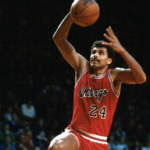 Reggie Theus brought a smooth scoring game to the NBA, combining creativity with the ability to take over stretches of a game when his team needed points. Beyond his years as a player, he remained connected to basketball through coaching and leadership roles, adding another chapter to a career that spanned far beyond the court.
Player Profile
Personal Information:
- Full Name: Reginald Wayne Theus
- Nationality: American
- Date of Birth: October 13, 1957
- Hometown: Inglewood, California, USA
- Height: 6 feet 7 inches (2.01 meters)
- Weight: 190 pounds (86 kilograms)
- Wingspan: 6 feet 8 inches
- Position: Shooting Guard / Small Forward
- Jersey Numbers: 24, 23, 25
Education:
- High School: Inglewood High School, Inglewood, California
- College: University of Nevada, Las Vegas (UNLV)
College Career:
At UNLV, Theus played under coach Jerry Tarkanian from 1976 to 1978. He averaged 12.9 points, 4.4 assists, and 4.3 rebounds per game over three seasons. As a sophomore, he helped lead the Runnin’ Rebels to their first Final Four appearance. In his junior year, he earned Second Team All-American honors with averages of 18.9 points, 6.8 rebounds, and 4.5 assists per game.
Professional Career:
- NBA Draft: Selected 9th overall in the first round of the 1978 NBA Draft by the Chicago Bulls.
- Teams Played For:
- Chicago Bulls (1978–1984)
- Kansas City/Sacramento Kings (1984–1988)
- Atlanta Hawks (1988–1989)
- Orlando Magic (1989–1990)
- New Jersey Nets (1990–1991)
- Career Highlights:
- Two-time NBA All-Star
- One of only nine players in NBA history to record at least 19,000 points and 6,000 assists.
Coaching Career:
- NBA Coaching:
- Head Coach of the Sacramento Kings (2007–2008)
- College Coaching:
- Head Coach at New Mexico State University
- Head Coach at California State University, Northridge
- Head Coach and Athletic Director at Bethune-Cookman University (appointed July 7, 2021)
Personal Life:
- Family: Theus is one of four children born to Felix and Willie Mae Theus. His parents divorced when he was four years old. His father, who owned a janitorial business, passed away before Reggie’s senior year in high school. Reggie briefly managed his father’s business after his passing.
Player Archetype / Play Style
Reggie Theus was a big combo guard who fit the archetype of a smooth scoring playmaker, blending shot creation with real passing feel rather than operating as a pure table-setter or pure gunner. Defensively, he was more of a perimeter matchup piece than a stopper, using his size to check guards and some wings without being the kind of player a team built its scheme around. On offense, he could handle, create off the dribble, run guard actions, and carry stretches as a lead scorer, which made him a difficult cover in the open floor and in half-court situations. Physically, Theus stood 6’6″ and 190 pounds, giving him tall-guard size, long strides, and enough fluidity to play either backcourt spot. His overall style was stylish and controlled: a confident, upright attacker with scoring flair, transition burst, and the vision to mix buckets with playmaking when the game opened up. (NBA)
Scouting Report
Reggie Theus always looked most dangerous when he had room to probe instead of rushing into a decision, because his game was built around reading defenders one step ahead rather than simply outrunning them. The first thing you notice is how comfortable he was operating from the wing or the top of the floor with the ball in his hands, using long strides, hesitation dribbles, and changes of pace to back defenders onto their heels before slipping into the lane. He wasn’t hunting difficult jumpers if a driving angle remained available, and once help rotated, he had the vision to thread passes to cutters or find shooters lifting from the weak side without overcomplicating the read. That’s what separated him from pure scoring guards. His size allowed him to see over smaller defenders, making post-ups and cross-court passes legitimate parts of his offense rather than occasional counters. The trade-off was that his perimeter shooting wasn’t consistent enough to force defenders into tight pressure every possession, so disciplined defenses could occasionally duck under actions or shade toward the paint, inviting outside attempts while clogging driving lanes. Defensively, he had the physical tools to bother opposing guards and wings, particularly when using his length to contest from behind or absorb contact on drives, but his focus could drift away from the ball, leading to late closeouts or missed rotations through multiple off-ball actions. To me, Theus fit best in an offense that gave him freedom to initiate without requiring him to orchestrate every possession, allowing another creator to share ball-handling duties while he attacked tilted defenses, posted smaller guards, and created advantages from secondary actions. It’s easy to overlook how patient he was around the rim because many of his finishes came after waiting for shot blockers to leave their feet rather than trying to beat them with raw explosiveness. Stylistically, his game blended elements of Penny Hardaway’s size and playmaking from the perimeter, albeit without the same level of efficiency, while parts of his slashing and mid-post attack also echoed Joe Johnson, relying on poise, body control, and shot creation instead of overwhelming speed. — Mat Diekhake, HeatingUp
Sources: Reggie Theus player profile — NBA.com; Running and Gunning with Reggie Theus, 1979 — From Way Downtown; Reggie Theus stats, height, weight, position, draft status and more — Basketball-Reference