
Last Updated on August 7, 2026 by Mat Diekhake
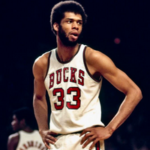
Kareem Abdul-Jabbar built an unmatched career around extraordinary skill, remarkable longevity, and the virtually unstoppable skyhook that became basketball’s most iconic signature shot. A six-time NBA champion and six-time MVP, he dominated across two decades while establishing himself as one of the most accomplished and influential players the game has ever known.
Here’s a detailed profile of basketballer Kareem Abdul-Jabbar:
- Full Name: Ferdinand Lewis Alcindor Jr.
- Nickname: The Tower from Power
- Nationality: American
- DOB: Born on April 16, 1947
- Hometown: New York City, New York, USA
- Height: 7 feet 1 inch (216 cm)
- Weight: 225 pounds (102 kg)
- Wingspan: 7 feet 5 inches (2.26 meters)
- Shoe Size: Size 16 (US)
- Number: 33
- Position: Center
- High School: Power Memorial Academy (New York City, NY)
- College: UCLA (UCLA Bruins)
- NBA Draft: 1969 (1st round, 1st pick overall by the Milwaukee Bucks)
- Teams Played For:
- Milwaukee Bucks (1969–1975)
- Los Angeles Lakers (1975–1989)
- Accolades:
- NBA Championships:
- 🏆 6-time NBA Champion: (1971 with the Milwaukee Bucks; 1980, 1982, 1985, 1987, 1988 with the Los Angeles Lakers)
- NBA Awards:
- 🥇 6-time NBA Most Valuable Player (MVP): (1971, 1972, 1974, 1976, 1977, 1980)
- Holds the record for the most regular-season MVP awards in NBA history.
- 🎖️ 2-time NBA Finals MVP: (1971, 1985)
- ⭐ 19-time NBA All-Star: (1970–1977, 1979–1989)
- 10-time All-NBA First Team: (1971–1974, 1976, 1977, 1980, 1981, 1984, 1986)
- 5-time All-NBA Second Team: (1970, 1978, 1979, 1983, 1985)
- 5-time NBA All-Defensive First Team: (1974, 1975, 1979–1981)
- 6-time NBA All-Defensive Second Team: (1970, 1971, 1976–1978, 1984)
- NBA Rookie of the Year: (1970)
- 2-time NBA Scoring Champion: (1971, 1972)
- NBA Rebounding Leader: (1976)
- 4-time NBA Blocks Leader: (1975, 1976, 1979, 1980)
- Career Totals & Achievements:
- 38,387 career points (Most points in NBA history until 2023, when LeBron James surpassed it)
- 17,440 career rebounds (4th all-time in NBA history)
- 3,189 career blocks (3rd all-time in NBA history)
- 5,660 career assists
- Most All-Star selections at the time of his retirement (19)
- Career averages: 24.6 points, 11.2 rebounds, and 2.6 blocks per game
- NBA Hall of Fame Inductee: 1995
- College Career:
- 🏆 3-time NCAA Champion: (1967, 1968, 1969 with UCLA)
- 3-time NCAA Tournament Most Outstanding Player
- Naismith College Player of the Year: (1969)
- 2-time USBWA College Player of the Year: (1967, 1969)
- Other Notable Achievements:
- NBA 50th Anniversary Team: (1996)
- NBA 75th Anniversary Team: (2021)
- Presidential Medal of Freedom: (2016) awarded by President Barack Obama
- Lou Gehrig Memorial Award: (1985) for contributions to society outside of sports
- NBA Championships:
- Kids: 3 (Kareem Abdul-Jabbar Jr., Diahann Carroll, and Adam Abdul-Jabbar)
- Siblings: Kareem Abdul-Jabbar has one sister, named Cheryl.
- Retirement Age: 41
- Retirement Year: 1988-89
Kareem Abdul-Jabbar’s player archetype is a dominant scoring center whose blend of size, balance, and touch made him one of basketball’s most unstoppable offensive forces. Towering with remarkable coordination, he anchored the paint defensively while controlling games through the skyhook, a signature shot that remained effective for two decades. His longevity, consistency, and polished interior game helped define an era of NBA excellence.
Scouting Report
Kareem Abdul-Jabbar had a rare ability to make difficult offense feel almost routine because he never seemed rushed, even when defenses threw extra bodies at him. Everyone remembers the skyhook, but what made it so devastating wasn’t just the release point—it was how patiently he worked for position beforehand, nudging defenders a step off balance, reading where the help was coming from and choosing the moment to shoot only after the defense had committed. That patience carried into the rest of his offensive game. He could score over either shoulder, hit cutters from the post when doubles arrived late, and comfortably operate from the high elbow where his touch and vision kept the offense flowing instead of stalling. The interesting thing is that opponents often had to choose between conceding one-on-one post touches or rotating early enough to expose the weak side, and Kareem rarely forced the issue when the second option appeared. Defensively, he anchored the paint with timing more than violence, using his length to challenge shots vertically, discourage drives before they developed and clean up possessions with secure rebounding rather than chasing highlight blocks. The trade-off came when possessions pulled him repeatedly away from the basket. He was most influential protecting the lane instead of defending multiple actions in open space, so teams asking him to switch or recover over large areas would naturally reduce some of his impact. To me, he’d be just as effective in a structured offense that mixed post seals with elbow actions, inverted pick-and-rolls and deliberate spacing because his decision-making punished impatient defenses every bit as much as his scoring did. It’s easy to overlook how often he created quality shots for teammates simply by drawing two defenders into uncomfortable positions. Stylistically, parts of his offensive control resemble Tim Duncan’s economy of movement, while his interior scoring gravity brings to mind Joel Embiid, although Kareem relied far more on precision, balance and one unstoppable signature weapon than physical collisions to dominate possessions.
Notes:
- Kareem Abdul-Jabbar’s height in shoes was officially listed at 7 feet 2 inches (218 cm) during his playing career. Without shoes, he measured approximately 7 feet 1 inch (216 cm).
- Kareem Abdul-Jabbar’s playing weight was typically listed at 225 pounds (102 kilograms) during his NBA career
- Similar players to Kareem Abdul-Jabbar include Hakeem Olajuwon.
Fun Facts
- Kareem Abdul-Jabbar’s high school teacher “Mr. Kelly” used to give him the keys to the gym during recess, tell him not to screw anything up in the gym, and then Kareem would practice basketball shots by himself in the gym. Beautiful teachers like that — who can empathize with the dreams of another man — are how NBA players are born.
- Shaquille O’Neal referred to Kareem Abdul-Jabbar as the greatest big man (center) to ever play the game.
Player Insights
Player Overview: Kareem Abdul-Jabbar invented the skyhook, which he frequently shot around the low post. His skyhook shots were long, arching, arm movements that made it difficult for defenders to block. Though he is most known as a Laker, he spent six seasons playing for the Milwaukee Bucks at the start of his career. Abdul-Jabbar nearly broke stat sheets, often putting up 30 and 15 games in his prime. To average this number is virtually unheard of since. The new common phrase for outstanding frontcourt players is 20 and 10. Abdul-Jabbar said that the reason no professional basketball players shoot the hook shot anymore is that they grow up watching players like Michael Jordan and Julius Irving and want to be like them. Jordan was known for his traditional basketball shot with two hands on the ball while Irving was known for his layups. I don’t think the death of the hook shot is related to Michael Jordan not doing them (at least not directly). When I grew up, coaches taught us how to shoot and they taught us the traditional shot and that was how we were to shoot the ball. It was emphasized exactly how the elbow should be facing the basket and so on. The hook shot is an element of the game that players should bring back in due time to help give the game more depth. 8/5/2024