
Last Updated on August 7, 2026 by Mat Diekhake
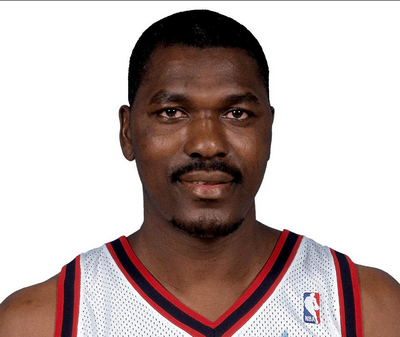
Hakeem Olajuwon combined graceful footwork, elite shot-blocking, and an unstoppable arsenal of post moves to become one of the most complete centers the NBA has ever seen. The two-time champion’s legendary “Dream Shake” left defenders guessing throughout a Hall of Fame career that showcased brilliance on both ends of the floor.
Here’s a detailed profile of basketballer Hakeem Olajuwon:
- Full Name: Hakeem Abdul Olajuwon
- Nationality: Nigerian-American
- DOB: Born January 21, 1963
- Hometown: Lagos, Nigeria
- Height: 7 feet 0 inches (2.13 meters)
- Weight: 255 pounds (116 kg)
- Wingspan: 7 feet 6 inches (2.29 meters)
- Shoe Size: Size 18 (US)
- Number: Wore #34 throughout his NBA career
- Position: Center / Power Forward
- High School: Attended Muslim Teachers College (Lagos, Nigeria; did not play organized basketball until college)
- College: University of Houston (1981–1984)
- NBA Draft: 1984 NBA Draft, 1st overall pick by the Houston Rockets
- Player Archetype: Two-way post-dominant center
- Primary Offensive Role: Low-post focal scorer (elite footwork, “Dream Shake”)
- Defensive Role: Rim protector and anchor (shot-blocking + switch capability)
- Play Style:
Highly technical post scorer with guard-like footwork, soft touch, and advanced counters; defensively agile with elite timing and anticipation - Handedness / Shooting Hand: Right-handed
- Athletic Profile:
Exceptional agility and coordination for size; elite lateral movement and balance uncommon for 7-foot centers - Recruiting Status:
Raw, late basketball convert with minimal exposure; not a traditional U.S. high school recruit - Draft Status Detail:
Consensus top prospect in historic 1984 draft class (selected ahead of Michael Jordan, Charles Barkley, and John Stockton) due to elite two-way center upside - Injury Status Category: Durable
Long prime with heavy minutes; maintained high performance into mid-30s with relatively limited major injuries - Career Stage: Retired (Hall of Fame career; peak in mid-1990s)
- Comparison Style:
Skill-based and footwork-centric comparisons emphasizing two-way dominance - Comparable Players:
- Kareem Abdul-Jabbar — elite post scoring craft and signature go-to moves
- Patrick Ewing — physical interior scoring with strong defensive anchoring
- Shaquille O’Neal — dominant paint presence with overwhelming interior efficiency
- Teams Played For:
- Houston Rockets (1984–2001)
- Toronto Raptors (2001–2002)
- Championship Rings: 2 (1994, 1995 with the Houston Rockets)
- Parents: Salim Olajuwon (father), Abike Olajuwon (mother)
- Kids: Has four children: daughters Abi, Rahmah, Aisha, and Khadija
- Siblings: Hakeem is one of eight children in his family
- Retirement Age: Retired at age 39
- Retirement Year: Officially retired after the 2001–2002 NBA season
Hakeem Olajuwon fits the player archetype of a two-way post-dominant center, anchoring the defense as an elite rim protector while serving as a primary offensive hub through the low post and mid-post. Defensively, he operated as a backline eraser with exceptional timing, lateral quickness, and instincts, allowing him to both contest at the rim and switch more comfortably than most centers of his era. Offensively, Olajuwon functioned as a go-to scorer, leveraging his “Dream Shake” footwork, touch, and counters to create efficient looks against any coverage, while also facilitating out of double teams. His physical traits—long arms, fluid agility, balance, and coordination—made him uniquely capable of blending finesse with power. The overall play style was defined by surgical footwork, patience, and two-way control, combining graceful scoring craft with relentless defensive impact in a way few big men have replicated.
Scouting Report
Watching Hakeem Olajuwon, the first thing that stands out isn’t the footwork everyone talks about—it’s how rarely he committed to a move before reading the defender’s balance. Every shoulder fake, pivot and spin was a reaction to what the defender gave him, which made his post game feel less rehearsed than improvised. He could score from either block, face up from the elbow, attack baseline or middle, and if the double team arrived too early he’d calmly fire passes to cutters or shooters without letting the possession speed him up. That’s why sending help against him was never as straightforward as it looked on a whiteboard. Defensively, he was just as disruptive. His timing as a rim protector allowed him to challenge shots without constantly chasing blocks, and what I’ve always thought separated him from many great centers was his ability to recover after the initial action. If he stepped up in pick-and-roll coverage, he had the agility to retreat, contest at the rim and often finish the possession with the rebound instead of becoming stranded in space. He could switch for short stretches, slide with quicker players long enough to buy time for teammates, and erase mistakes with late rotations that most bigs simply couldn’t make. The trade-off was that he occasionally trusted his one-on-one brilliance enough to hunt difficult post possessions instead of moving the ball immediately against loaded defenses, but even those possessions usually generated a quality look because of how much attention he demanded. Put him in almost any offensive system and he’d find ways to dominate, though an offense built around inside-out spacing, patient entry passes and intelligent weak-side movement would unlock every layer of his game. Stylistically, there’s a blend of Joel Embiid’s scoring versatility and Bam Adebayo’s defensive mobility in what he offered, but neither truly captures the seamless way Olajuwon combined elite rim protection, perimeter agility and arguably the most adaptable post repertoire the game has ever seen.
Notes:
- In terms of play style, Hakeem Olajuwon most closely mirrors David Robinson in mobility, defensive range, and face-up ability. Elements of his footwork-driven scoring translate to Joel Embiid as a modern evolution, while Tim Duncan reflects a more structured, fundamentally disciplined version of two-way interior control.
Player Insights
Player Overview — February 11, 2025
Hakeem Olajuwon is broadly regarded as the greatest player in Houston Rockets history, a view grounded in both production and legacy. While personal preferences may vary—some fans lean toward Tracy McGrady—Olajuwon’s standing is shaped by leading Houston to back-to-back NBA championships in 1994 and 1995 during Michael Jordan’s temporary absence. Those Finals runs, particularly against the New York Knicks, drew global attention and helped define the era, with Olajuwon’s skill, footwork, and two-way dominance leaving a lasting impression on fans worldwide.
Sources:
NBA — Hakeem Olajuwon Bio
Basketball Reference — Hakeem Olajuwon
The Ringer — The Case for Hakeem Olajuwon as the Best Center Ever