
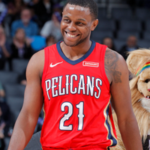
 Darius Miller built a reputation as a versatile wing who could contribute in a variety of ways, whether it was spacing the floor, moving the ball, or defending multiple positions. His steady approach and willingness to do the little things made him a useful role player throughout his professional career in both the NBA and overseas.
Player Profile
- Full Name: Darius Tiyon Miller
- Nationality: American
- Date of Birth: March 21, 1990
- Birthplace: Maysville, Kentucky, USA
- Height: 6 feet 6 inches (1.98 meters)
- Weight: 225 pounds (102 kg)
- Wingspan: 6 feet 7 inches
- Shoe Size: Size 14 (US)
- Position: Small Forward
- Jersey Numbers: 2, 21, 12
- High School: Mason County High School (Maysville, Kentucky)
- Led Mason County High School to a state championship in 2008.
- Named Kentucky Mr. Basketball in 2008.
- College: University of Kentucky (2008–2012)
- Played 152 games, the most in the university’s history.
- Part of the 2012 NCAA Championship team.
- NBA Draft: 2012, 2nd round, 46th overall pick by the New Orleans Hornets.
- Professional Teams:
- New Orleans Hornets/Pelicans (2012–2014, 2017–2020)
- Brose Bamberg (Germany) (2015–2017)
- Oklahoma City Thunder (2020–2021)
- Championships:
- NCAA Champion with the University of Kentucky (2012)
- 3× Bundesliga Champion with Brose Bamberg (2015–2017)
- German Cup Winner (2017)
- Parents: Brian and Nicole Miller
- Siblings: Information not publicly available
- Children: Information not publicly available
Player Archetype / Play Style
Darius Miller fit the archetype of a versatile 3-and-D wing, a sturdy perimeter forward with enough size to slide between wing spots while helping a team without monopolizing the ball. Offensively, he was best as a floor spacer and connective piece: a spot-up shooter who moved well without the ball, made simple reads, and could attack a hard closeout when defenses overplayed his jumper. Defensively, he projected as a solid scheme wing rather than a pure stopper, using his frame, footwork, and discipline to stay in front of players and cover complementary assignments on the perimeter. Physically, Miller was listed at 6-foot-6 and 225 pounds by NBA.com, while draft measurements also highlighted his strong frame and near-6-foot-8 size in shoes, which helps explain why he looked comfortable as a bigger wing. In plain terms, his style was practical and winning-oriented: defend his spot, space the floor, keep the ball moving, and make life easier for the higher-usage players around him. (NBA)
Scouting Report
Darius Miller was the type of wing whose value became more obvious the longer you watched rather than the louder the box score became. What stands out is how cleanly he fit into offensive structure without interrupting it. He understood when to stay wide in the corner, when to lift behind a drive, and when to slide into the next passing window after the ball changed sides, which meant he was almost always available as an outlet without demanding touches. His shooting was the foundation, but it worked because his footwork was consistently prepared before the catch, allowing him to get shots away quickly against late closeouts. If defenders flew at him, he usually took the simple solution instead of chasing highlights, attacking in straight lines, making the extra pass, or finishing before secondary help could rotate. That’s where his game separated itself from many spot-up specialists. He wasn’t trying to manufacture difficult offense off the dribble, yet he rarely stalled a possession by forcing something outside his comfort zone. Defensively, Miller relied on positioning, communication, and anticipation more than recovery speed. He navigated off-ball actions with discipline, rotated from the weak side on time, and generally understood when to sink toward the nail or recover to shooters, although explosive scorers capable of changing direction multiple times could expose his average lateral quickness in isolation. The trade-off was that he wasn’t someone you handed the ball to when the offense broke down. His impact depended on the flow around him rather than his ability to create against a set defense. To me, he fit best alongside high-usage guards and playmaking forwards who consistently bent the defense, allowing him to space the floor, keep the ball moving, and punish defensive overreactions without becoming the focal point. It’s easy to overlook players like Miller because so much of what they do happens one pass before the assist or one rotation before the stop, but coaches tend to notice those details. Stylistically, his game shared similarities with Mike Dunleavy Jr. as a cerebral floor spacer who made quick decisions, while parts of his role also resembled James Jones, valuing timing, spacing, and dependable execution over individual shot creation.
Sources: NBA.com — “Darius Miller | Forward”; NBADraft.net — “Darius Miller”; Kentucky Athletics — “Darius Miller”; Sports Reference CBB — “Darius Miller College Stats”