
Last Updated on August 12, 2026 by Mat Diekhake
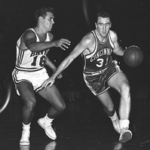 Jack Twyman was one of the NBA’s early scoring stars, earning recognition for his offensive skill and consistency during a period when professional basketball was still finding its footing. Beyond his achievements on the court, he is remembered for his remarkable loyalty and compassion, qualities that left an enduring legacy within the sport.
Player Profile
Personal Information:
- Full Name: John Kennedy Twyman
- Nationality: American
- Date of Birth: May 21, 1934
- Place of Birth: Pittsburgh, Pennsylvania, USA
- Date of Death: May 30, 2012
- Place of Death: Cincinnati, Ohio, USA
- Height: 6 feet 6 inches (198 cm)
- Weight: 210 pounds (95 kg)
- Wingspan: 6 feet 7 inches
- Position: Small Forward
- Jersey Numbers: 10, 27, 31
Education:
- High School: Central Catholic High School, Pittsburgh, Pennsylvania
- College: University of Cincinnati (1951–1955)
Professional Career:
- NBA Draft: Selected by the Rochester Royals in the second round as the 8th overall pick of the 1955 NBA Draft.
- Teams Played For: Rochester Royals / Cincinnati Royals (1955–1966)
- Career Highlights:
- 6× NBA All-Star (1957, 1958, 1959, 1960, 1961, 1962)
- 2× All-NBA Second Team (1960, 1962)
- Inducted into the Naismith Memorial Basketball Hall of Fame in 1983
- His jersey number 27 was retired by the Sacramento Kings
- Twyman is a namesake of the NBA’s Twyman-Stokes Teammate of the Year Award
Personal Life:
- Family: Jack Twyman was married to Carole Twyman. They had six children together. Specific information about his siblings is not widely documented.
Player Archetype / Play Style
Jack Twyman was a pure-scoring wing, essentially a shooting forward who blended perimeter touch with enough size to play either forward or big guard roles for his era; defensively, he profiled more as a sound positional defender than a disruptive stopper, with offense clearly driving his value; offensively, he was a featured scorer who leaned on polished shooting, high-volume jump scoring, and steady half-court production rather than bruising interior play or primary playmaking. Listed at 6-foot-6 and 210 pounds, Twyman had strong size for the 1950s and 1960s wing game, which helped him score over smaller defenders while still working comfortably from the perimeter. In total, his style was smooth and efficient: a high-level shooter and offensive focal point whose game was built on skill, balance, and dependable scoring production. (Basketball Reference)
Scouting Report
Jack Twyman played with an attacking mindset that felt ahead of his era because he constantly searched for ways to score before the defense had a chance to settle. The first thing you notice is how active he was without the ball. He ran hard in transition, cut decisively from the weak side, and flowed into scoring areas instead of waiting for the offense to come to him, which made him difficult to track over the course of a game. In the half court, he was at his best facing the basket, using long strides, sharp footwork, and a soft touch from the mid-range to create clean looks without relying on elaborate dribble combinations. If defenders crowded him, he was comfortable putting the ball on the floor for a direct drive or finishing through contact around the rim, and while he wasn’t a primary playmaker, he consistently made the simple read when extra help arrived instead of forcing contested attempts. That’s where his offensive efficiency came from. Defensively, Twyman competed with good awareness, rotating into the lane to help on drives and using anticipation to contest shots before they reached the basket, though he wasn’t the type to overwhelm opponents with length or erase mistakes as a rim protector. Physical frontcourt players could move him closer to the paint than he preferred, and quicker perimeter scorers had success if they forced him into extended one-on-one possessions away from help. The trade-off was that much of his value depended on maintaining offensive rhythm rather than dictating every possession himself. To me, he fit best alongside an inventive lead guard capable of drawing multiple defenders, allowing Twyman to thrive as a constant scoring threat coming off movement, attacking closeouts, and exploiting defensive rotations that had already been set in motion. It’s easy to overlook how much pressure his continuous movement created because defenders were rarely guarding the same action for long before he was cutting into another scoring opportunity. Stylistically, his game shared similarities with Adrian Dantley in the way he combined touch and physicality inside the arc, while elements of his off-ball scoring and polished footwork also foreshadowed Chris Mullin, particularly in how he generated quality shots through timing rather than overwhelming athleticism. — Mat Diekhake, HeatingUp
Sources: Basketball-Reference — Jack Twyman Stats, Height, Weight, Position, Draft …; Britannica — Jack Twyman | NBA Hall of Famer, 6x All-Star