
Last Updated on August 12, 2026 by Mat Diekhake
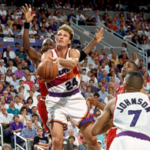 Tom Chambers was one of the NBA’s premier scoring forwards during the 1980s and early 1990s, blending size, athleticism, and a polished offensive game that made him difficult to defend. His ability to produce points in a variety of ways helped him enjoy a long career and establish himself as one of the standout players of his era.
Player Profile
Personal Information:
- Full Name: Thomas Doane Chambers
- Nationality: American
- Date of Birth: June 21, 1959
- Place of Birth: Ogden, Utah, USA
- Height: 6 feet 10 inches (208 cm)
- Weight: 220 pounds (100 kg)
- Wingspan: 6 feet 11 inches
- Position: Power Forward
- Jersey Numbers: 22, 24, 25
Education:
- High School: Fairview High School, Boulder, Colorado
- College: University of Utah
Professional Career:
- NBA Draft: Selected by the San Diego Clippers in the 1st round (8th overall) of the 1981 NBA Draft
- NBA Teams Played For:
- San Diego Clippers (1981–1984)
- Seattle SuperSonics (1984–1988)
- Phoenix Suns (1988–1993)
- Charlotte Hornets (1993–1994)
- Philadelphia 76ers (1994–1995)
- Utah Jazz (1995–1997)
Career Highlights:
- NBA All-Star Selections: Four-time All-Star (1987–1990)
- All-NBA Honors: Two-time All-NBA selection
- NBA All-Star Game MVP: 1987
- Career Achievements:
- Over 20,000 points scored in the NBA
- Phoenix Suns retired his #24 jersey in honor of his contributions to the team
Personal Life:
- Family: Information about Tom Chambers’ family, including children and siblings, is not widely documented.
Player Archetype / Play Style
Tom Chambers was an athletic scoring forward, essentially a face-up power forward who brought wing-like mobility to a big-man role; defensively, he was more of a functional team defender than a true stopper, using size and movement well enough to cover frontcourt assignments without making defense the center of his value; offensively, he did his best work as a high-volume scorer who ran the floor, attacked off the dribble, finished above the rim, and stretched defenses with touch from mid-range and, later, from three. At 6-foot-10 and 220 pounds, Chambers had unusual fluidity for his size, which is a big reason he could play with more speed and skill than many traditional power forwards of his era. The overall style was aggressive but smooth: a mobile frontcourt scorer who could fill lanes, rise over defenders, and pressure defenses with athletic finishing and polished face-up offense. (NBA)
Scouting Report
Tom Chambers played with a scorer’s mentality, but what separated him from many high-volume forwards was how many different ways he could arrive at the same result. The first thing you notice is how aggressively he attacked from the elbows and high post, forcing bigger defenders to move their feet before using long, fluid strides to get all the way to the rim or pulling up when they retreated too far. He ran the floor exceptionally well, filled lanes in transition with purpose, and was an underrated threat slipping into open space after screening because defenders often underestimated how quickly he could explode toward the basket. Around the paint, he wasn’t simply overpowering opponents. His footwork, balance, and touch allowed him to score through contact or over either shoulder, and if the defense collapsed late, he was capable of making the straightforward kick-out pass without trying to overcomplicate the possession. The trade-off was that he wasn’t an offensive hub who consistently manipulated entire defenses with his passing. Once extra defenders arrived early, his instinct leaned toward finishing the play himself, and that occasionally led to difficult attempts over length instead of swinging the ball to reset the offense. Defensively, Chambers was at his best when he could use his mobility to contest face-up forwards, rotate from the weak side, and finish possessions with rebounds, but stronger post scorers could establish deep position against him, while quicker perimeter players could expose him if he was switched too far from the basket. To me, his ideal role was as an attacking power forward next to a true playmaking guard who could force defensive rotations, giving Chambers opportunities to punish tilted defenses rather than asking him to initiate every half-court possession himself. It’s easy to overlook how much pressure his transition game placed on opponents because many of his best scoring chances were created before the defense had any chance to match up. Stylistically, his game shared similarities with Amar’e Stoudemire’s relentless rim pressure from the frontcourt, though Chambers relied more on face-up skill than vertical explosion, while elements of his offensive approach also echoed Chris Webber’s ability to attack from the high post without functioning as the primary playmaker. — Mat Diekhake, HeatingUp
Sources: NBA.com — Tom Chambers | Forward | NBA.com; Basketball-Reference — Tom Chambers Stats, Height, Weight, Position, Draft …; Back Sports Page — Tom Chambers’ Journey Through The Wild West